The Real Cost of School Uniforms in Australia (And What Smart Parents Are Doing About It)
Every January, Australian parents face the same ritual: the school uniform shop queue. The list is long. The prices are longer.
Most families don't tally the total until they're standing at the counter. By then, it's too late to reconsider the blazer.
This post breaks down exactly what Australian families are spending on school uniforms, why prices have climbed so sharply, and what a growing number of parents are doing to cut that bill significantly — without compromising on quality.
How Much Do School Uniforms Actually Cost in Australia?
The short answer: a lot more than most families budget for.
According to research from the Australian Scholarships Group and various state-based cost-of-education surveys, the average Australian family spends $1,200 to $1,800 per child, per year on education-related clothing and footwear. For families with two or more school-age children, that's easily $3,000 to $5,000 a year — before you've paid a single school fee.
Breaking it down by item for a typical secondary school student:
| Item | Average New Price |
|---|---|
| Winter blazer | $180 – $320 |
| Sports uniform set | $120 – $200 |
| Summer dress / formal pants + shirt | $80 – $150 |
| Winter pants / skirt | $60 – $110 |
| School shoes | $90 – $180 |
| PE shoes | $60 – $120 |
| School bag | $80 – $160 |
| Hats, ties, socks, accessories | $40 – $80 |
Total for one secondary student: $710 – $1,320 at retail.
Primary school is slightly cheaper but still substantial — most families report spending $400 to $800 to kit out a primary-age child from scratch.
The Hidden Costs Parents Don't Plan For
The initial outfitting is only the beginning. Most families face additional uniform costs throughout the year:
Growth spurts. Children don't wait for the new school year to outgrow their uniforms. A blazer bought in January can be too short by June. Many families end up purchasing replacements mid-year at full retail price.
Multiple sets required. Most schools recommend (and many quietly require) two to three sets of everything so that uniforms can be washed during the week. Double the uniforms, double the cost.
Subject-specific requirements. Woodshop aprons. Science lab coats. PDHPE uniforms. Drama costumes. Each subject adds to the list.
Year-to-year changes. Schools occasionally update uniform designs — new logos, revised colour schemes, updated sports kits. Parents who've carefully stored last year's uniform may find it no longer meets the current policy.
The total over a school career from Prep to Year 12 can easily exceed $15,000 per child in uniform costs alone.
Why School Uniforms Cost So Much in Australia
Unlike most clothing, school uniforms are subject to a near-monopoly at the point of sale. Most schools mandate purchasing from a single approved supplier — often the school's own uniform shop or a contracted retailer — which eliminates price competition entirely.
A few factors drive costs up:
- Mandatory branding. Embroidered logos and school-specific colours mean uniforms can't be sourced from general retailers like Target or Kmart, even when the underlying garment is identical.
- Small production runs. Uniforms for individual schools are produced in limited quantities, which removes the economies of scale that bring clothing prices down in the general market.
- Vertical integration. Many school uniform suppliers also supply directly to the school and receive a commercial arrangement that keeps prices high.
- No comparison shopping. Parents have one option: buy from the designated supplier at the listed price.
The result is a captive market. And parents pay the price — quite literally.
How Long Do School Uniforms Actually Last?
Here's the uncomfortable maths: most school uniforms are outgrown before they wear out.
A child in primary school grows an average of 5 to 8 centimetres per year. At that rate, a uniform bought to fit well in Term 1 may be visibly too small by Term 3 of the same year. In practice, most items get 12 to 18 months of actual wear before they're retired — not because they're damaged, but because they no longer fit.
This means a $280 blazer — worn for 18 months — effectively costs $186 per year. For a garment that ends up sitting in a box.
Multiply that across every item in the uniform, across every child, and the waste becomes staggering. Millions of dollars worth of school uniforms sit unused in wardrobes and storage boxes across Australia every year, in perfectly wearable condition.
What Smart Parents Are Doing About It
An increasing number of Australian families have quietly worked out a better approach: buying and selling second hand school uniforms instead of buying new.
The logic is straightforward:
- A second hand blazer in very good condition sells for $40 to $80 — compared to $180 to $320 new.
- A second hand sports set typically goes for $15 to $40 — versus $120 to $200 new.
- Most items listed as "like new" or "very good" have been worn for one season or less.
For a family outfitting a secondary school student entirely from second hand sources, savings of $500 to $900 per child are achievable — without sacrificing quality.
More importantly, the uniforms they're outgrowing can be sold rather than stored. A uniform set that cost $400 new and is sold second hand for $120 to $180 effectively reduces the real cost of ownership dramatically.
Where to Buy Second Hand School Uniforms in Australia
Until recently, your options were limited: check whether the school ran a second hand uniform stall (many do, but they operate infrequently and have unpredictable stock), post in the local Facebook parent group, or hope someone listed in Gumtree.
Each option has obvious limitations. The school stall might not have your size. Facebook groups are unstructured and you're often posting blind. Gumtree mixes uniforms with everything else and has no school-specific filtering.
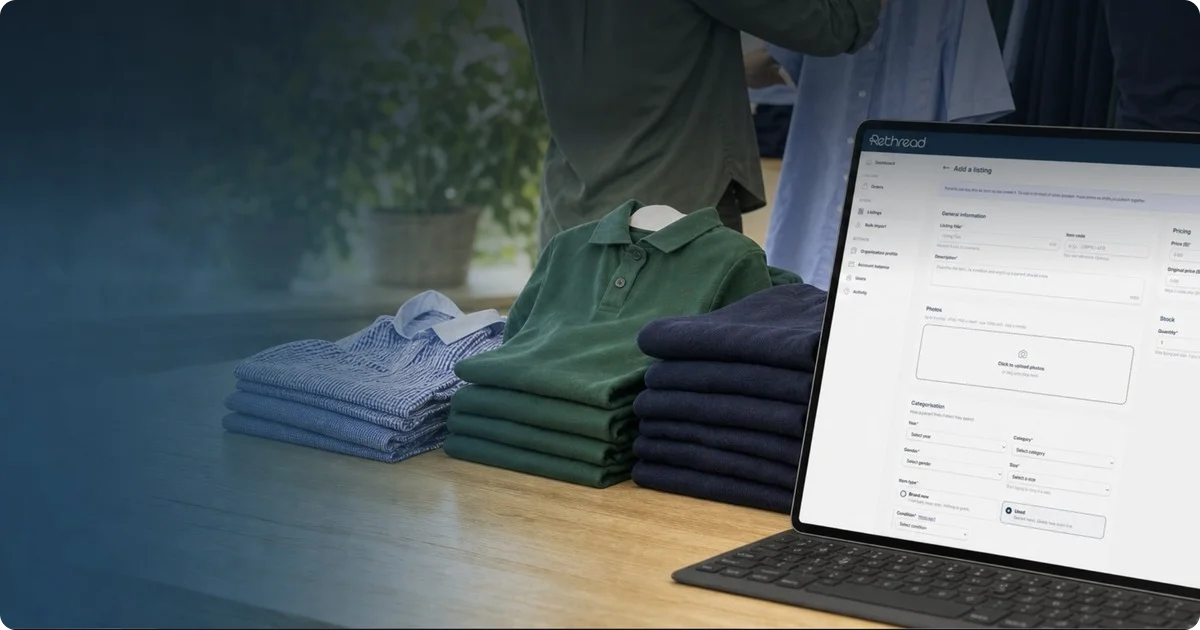
Rethread was built specifically to solve this. It's a dedicated marketplace for second hand school uniforms, organised by school. Every one of Australia's 10,604 primary and secondary schools is listed. Parents can search directly for their school and see all available listings — filtered by size, condition, and item type.
There's no commission for buyers. Sellers list for free. And unlike a Facebook post or a school stall, listings are available 24 hours a day, not just on the third Saturday of the term.
How to Buy Second Hand School Uniforms (and Actually Get a Good Deal)
A few things to look for when buying pre-loved uniforms:
Check the condition grading carefully. Look for "Like New" or "Very Good" condition listings. These typically mean the item has been worn for one year or less and has no visible wear. "Good" condition usually means two to three years of wear — still fine for most items, but worth inspecting the photos closely on anything with collars or cuffs that show wear early.
Buy slightly large. If you're buying at the start of the year and your child is mid-growth-spurt, buy one size up. A slightly large shirt can be tucked in. A too-small blazer is unwearable.
Buy in sets. Many sellers list multiple items at once when a child has finished at a school or moved up a year. Buying a set is often cheaper than buying items individually and means everything matches.
Time your purchase. The best stock appears in December and January (end of year sell-offs) and in July (mid-year transitions). If you're buying mid-term, stock will be thinner but prices are often lower as sellers who haven't shifted items will drop their asking price.
How to Sell Your Child's Old School Uniforms
The other half of the equation. Selling outgrown uniforms recovers money you've already spent — and helps another family in the process.
Sell early. The best time to list is December and January, when families are actively shopping for the new school year. Mid-year is the second-best window. Listing in March or April means you're competing for attention in a quieter market.
Photograph well. Lay items flat on a clean surface in natural light. Show the school badge clearly. If there's any wear or minor damage, photograph it — buyers appreciate honesty and it avoids disputes.
Price realistically. A good rule of thumb: list at 30 to 40% of the original retail price for items in very good condition, 20 to 25% for good condition. Pricing too high means items sit unsold; pricing too low leaves money on the table.
Bundle where you can. A lot of $10 items is harder to sell than a bundle listed at $45. Buyers prefer fewer transactions.
The Numbers: What You Could Actually Save
Let's run the numbers for a typical secondary school family.
Buying new (retail): Full secondary uniform kit: ~$900 Annual replacement/growth items: ~$200 Total per year: ~$1,100
Buying second hand + selling outgrown: Full kit bought second hand: ~$300 Sales of outgrown items: ~$150 recouped Net annual cost: ~$150
Over the course of a six-year secondary education, that's a difference of roughly $5,700 per child — enough to cover a significant chunk of a school camp, a laptop, or extracurricular activities.
The Environmental Case
The financial argument is compelling enough on its own. But there's a broader picture worth noting.
Australia sends an estimated 500,000 tonnes of textiles to landfill every year, and school uniforms — outgrown quickly, made from synthetic blends that don't break down — are a significant contributor. A uniform that's bought second hand instead of new avoids the manufacturing footprint of a new garment. A uniform that's sold instead of binned stays in use rather than in landfill.
For a family with three school-age children across a combined 15 years of schooling, buying and selling second hand instead of buying new and discarding could divert 15 to 20 kilograms of textile waste from landfill over that period.
Final Thoughts
School uniforms in Australia are expensive by design — and the system isn't set up to change. But families don't have to accept the retail price as the only option.
Buying second hand school uniforms for your school cuts costs by 60 to 70%. Selling outgrown uniforms recovers a meaningful portion of what you've spent. And the quality on offer — because most uniforms are outgrown, not worn out — is often indistinguishable from new.
If you're shopping for uniforms for the year ahead, search for your school on Rethread and see what's available. If you've got a wardrobe full of uniforms your kids have grown out of, listing them takes less than five minutes — and it's free.
Rethread is Australia's dedicated marketplace for second hand school uniforms. Every Australian school is listed. Free to list, 0% commission.
Common questions
How much do school uniforms cost in Australia?
A full set of new school uniforms typically runs from around $300 to $600 or more per child, before shoes, bags and sport gear. Costs are higher at high school and private schools, and multiply quickly for families with more than one child or kids going through growth spurts.
Why are school uniforms so expensive?
Uniforms are often tied to a single approved supplier with little competition, use school-specific logos and fabrics, and are bought new at set times of year. Add compulsory extra items like blazers, hats and sport kit, plus replacements as kids grow, and the total climbs well beyond the headline price of a shirt.
How can I save money on school uniforms?
Buying second-hand is the single biggest saving, especially on expensive pieces like blazers and jumpers that are often barely worn. Buy slightly larger so items last longer, check your school or P&C's second-hand shop, and look at dedicated marketplaces like Rethread that list pre-loved uniforms by school.
How long do school uniforms last?
It depends more on how fast a child grows than on wear — many uniform items are replaced because they're outgrown, not worn out. That's exactly why second-hand uniforms are such good value: plenty of pieces come back onto the market in near-new condition.
Where can I buy cheap second-hand school uniforms?
Try your school's own second-hand uniform shop or swap, community and parent Facebook groups, op shops, and dedicated online marketplaces like Rethread that list pre-loved uniforms by school. Buying the priciest items — blazers and jumpers — second-hand first is where you'll save the most.
Got uniforms you no longer need?
Rethread is Australia's free marketplace to buy and sell second hand school uniforms. List your items in minutes and help another family save.